Reference: Modern View of the Immune System
The Components
White blood cells known as lymphocytes form one of the most important
components of the immune system. The cells destined to become
lymphocytes originate in the bone marrow. Some of them travel in the
blood to the thymus gland in the neck, where they mature into
T-lymphocytes. The thymus gland seems to have a role in ensuring
that only those T cells that recognize foreign proteins (as opposed
to the body's own proteins) are released into the circulation. Some
of the immature cells remain in the bone mar row for the rest of their
development, however, and they become B-lymphocytes. Once mature, the
T and B cells migrate in the blood to the spleen, the lymph nodes and
other components of the lymphoid tissue, such as the tonsils. The
spleen is an organ found on the left side of the body, just below
the diaphragm. One of its functions is to filter circulating
microorganisms from the blood. Lymphocytes present in the spleen are
ready to respond to any foreign microbe that appears.
The lymph nodes, present throughout the body, filter the lymph - a
clear fluid that drains from the body tissues. The lymph collects in
the vessels of the lymphatic system, and eventually returns to the blood.
It first passes through the lymph nodes and any microorganisms or
cancer cells are filtered out. If an infection is present, lymphocytes
respond by multiplying, which accounts for the swelling of the nodes - for
example, in the armpits and under the lower jaw - that sometimes occurs.
Vast numbers of other types of white blood cell, e.g. microphages
(neutrophils) and macrophages, can engulf and destroy microorganisms.
They also destroy red blood cells that have reached the end of their
120-day life span. These so-called phagocytic cells are found in the
tissues, lymph nodes and spleen.
Antigens and Antibodies
An antigen is any foreign substance - for instance, the protein on the
coat of a bacterium - that can stimulate an immune response. When T
cells meet antigens they respond by multiplying and dividing, releasing
molecules that stimulate other cells of the immune system (including
other T cells) to grow.
There are may different kinds of T cells. Cytotoxic T cells can
recognize and kill cells infected with viruses. T-helper cells can help
macrophages to kill microorganisms. T-helper cells also have an important
role in stimulating B cells.
Once stimulated, a B cell multiplies. Its offspring mature into plasma
cells, which secrete antibodies. These are specialized molecules that
can latch on to antigens and help the rest of the immune system eliminate
the foreign particle. There is potentially an infinite variety of
anti-bodies, one for every conceivable antigen. Once a B cell is
stimulated, the result is a clone of plasma cells, all dedicated to
manufacturing the antibody that recognizes the antigen in question.
Immunity and Memory
A few of the cells that result when a B cell divides in response to
an antigen are so-called memory cells. These remain in the body for life:
when the individual meets the same antigen again, they are ready to
respond, faster and with more force than before. This explains why people
who have one attack of rubella (German measles), for example, are immune
to subsequent infections by this virus.
Immunization works on this principle. Vaccines aim to prime the
immune system to recognize disease-causing organisms, so that it will
spring into action when it encounters the microorganisms concerned.
Several vaccines consist of bacteria or viruses that have been killed
or weakened; they provoke a protective immune response, but no longer
have the capacity to cause the disease.
The Modern View of AIDS
The human immunodeficiency virus (HIV), which causes AIDS (Acquired
Immune Deficiency Syndrome), strikes at the heart of the body's defenses.
The virus destroys the immune system, including the very cells that
should be capable of eliminating it. In infected people the virus is
found in the blood, semen and - to a lesser extent - vaginal secretions.
It can be transmitted if any of these fluids gains access to another
person's blood stream. This can occur through sexual contact involving
exposure to semen, as the virus could enter even the most minute cut
or abrasion in the vagina or the more delicate rectum. It can also be
spread among drug users via shared hypodermic needles.
People infected with HIV may remain apparently well for many years.
After a variable incubation period, which may average as long as 9 or
10 years, many affected people - although no one knows exactly what
proportion - will go on to develop AIDS. The disease develops
when the individual's level of T-helper cells falls drastically.
Without the T-helper cells, which orchestrate many of the components
of the immune system, it becomes impossible for the body to fight off
infectious agents. The person falls prey to a variety of opportunistic
infections, so called because they have taken advantage of the failing
immune system. Certain cancers, including the skin cancer known as
Kaposi's sarcoma, may also develop in AIDS.
Medical scientists studying AIDS have been puzzled by the observation
that HIV seems to infect only a very small proportion of T-helper cells
circulating in the blood. Even if these infected cells died, the body
would produce T cells at such a rate that they would easily be replaced.
One theory to explain the loss is that some effects of the virus
on uninfected cells may be to blame. For example, viral proteins
circulating in the blood may attach themselves to the cells that HIV
attacks. Cytotoxic T cells may then see these cells as infected (even
though they are not) and kill them.
HIV infects not only T-helper cells, but also macrophages. Sometimes
the virus can multiply within the macrophages to the point where the
cells are bursting with viruses. Possibly, the primary defect in AIDS
may lie with the macrophages.
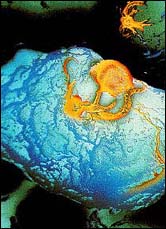
An AIDS virus (orange) budding from the plasma membrane (blue) of an
infectedT-lymphocyte, viewed through a false-color electron microscope.
| 








 This website is published, edited and designed by Raymond Cheng,
and reflects only and only his personal views and opinions in his individual capacity.
The information available at this website is not intended
directly or by implication to either diagnose or treat any
medical, emotional, or psychological condition or disorder.
It is also not intended to create a physician-patient relationship
between you and I or between you and Wyith Institute™ and The Office of Dr Raymond K K Cheng.
The information here is not a substitute for advice and treatment provided
by your physician or by another healthcare professional.
It is always recommended that consultation with local healthcare providers
be obtained for any of your specific health or medical concerns.
Furthermore, any products that can be purchased (yet you can see I don't have much
to sell here) through advertisers' banners or through links to other websites
are not either explicitly or implicitly given any warranty or endorsement
by me, my colleagues, Wyith Institute™ or any of its associated businesses.
This website is published, edited and designed by Raymond Cheng,
and reflects only and only his personal views and opinions in his individual capacity.
The information available at this website is not intended
directly or by implication to either diagnose or treat any
medical, emotional, or psychological condition or disorder.
It is also not intended to create a physician-patient relationship
between you and I or between you and Wyith Institute™ and The Office of Dr Raymond K K Cheng.
The information here is not a substitute for advice and treatment provided
by your physician or by another healthcare professional.
It is always recommended that consultation with local healthcare providers
be obtained for any of your specific health or medical concerns.
Furthermore, any products that can be purchased (yet you can see I don't have much
to sell here) through advertisers' banners or through links to other websites
are not either explicitly or implicitly given any warranty or endorsement
by me, my colleagues, Wyith Institute™ or any of its associated businesses.
 Thank you for visiting this TCM and acupuncture information website.
If you have previously been to this website, you might have
noticed that some of the pages on ancient historical ideas and
holistic thinkings related to Chinese metaphysics are temporarily taken offline.
This is because I will be revamping the whole website and be moving
those information into a new \"Ancient Chinese Culture\" section
so as to reflect a more current perspective on the interpretation
of some of the fundamental concepts as well as to include
some of the latest information in the area.
But if you have just found this website for the very first time, I welcome you again and
wish you could find what you require and, hopefully, you could also be benefitted
from reading the articles I published on this website.
Thank you for visiting this TCM and acupuncture information website.
If you have previously been to this website, you might have
noticed that some of the pages on ancient historical ideas and
holistic thinkings related to Chinese metaphysics are temporarily taken offline.
This is because I will be revamping the whole website and be moving
those information into a new \"Ancient Chinese Culture\" section
so as to reflect a more current perspective on the interpretation
of some of the fundamental concepts as well as to include
some of the latest information in the area.
But if you have just found this website for the very first time, I welcome you again and
wish you could find what you require and, hopefully, you could also be benefitted
from reading the articles I published on this website.