| ||||||
| ||||||
|







|
|
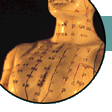
WHAT IS TRADITIONAL CHINESE MEDICINE? Photo © Image DJ Image Dictionary
With over 3000 years of experience, Traditional Chinese Medicine (TCM) has
remain one of the many fascinating areas in ancient Chinese culture.
First known to be documented in the Yellow Emperor's Canon of Medicine,
TCM is believed to have been practised in as early as 475 to 221 B.C.
The field of working knowledge of TCM stretches from anything related to
general healthcare practice to the philosophy of the mind, the logic of life,
religion, and even to as far as cosmology and astronumerology. This is why
in order to thoroughly understand the concepts behind TCM, one must be
comprehensive in learning and embracing the Chinese culture as a whole.
Just as Douglas Hoff put it when he explained about accupuncture, "The systems
of TCM uses the concepts of elements and meridians and are completely immersed
in the Asian cosmology which takes shape through the religions." The meridian-brain mechanism,
the fundamental working concept of acupuncture, in which the pain block from the message
that the needle or burning cone of herbs gives to the point of stimulus,
was only found centuries later by the West through science and technology.
|
|
MESSAGE FROM THE EDITOR – MARCH 2020
Please be patient and do come and check out this website frequently as it's being revamped.
Raymond Cheng, PhD DPA FRSA FRSPH |
|
|
IMPORTANT NOTICE AND DISCLAIMER This website is published, edited and designed by Raymond Cheng,
and reflects only and only his personal views and opinions in his individual capacity.
The information available at this website is not intended
directly or by implication to either diagnose or treat any
medical, emotional, or psychological condition or disorder.
It is also not intended to create a physician-patient relationship
between you and I or between you and Wyith Institute™ and The Office of Dr Raymond K K Cheng.
The information here is not a substitute for advice and treatment provided
by your physician or by another healthcare professional.
It is always recommended that consultation with local healthcare providers
be obtained for any of your specific health or medical concerns.
Furthermore, any products that can be purchased (yet you can see I don't have much
to sell here) through advertisers' banners or through links to other websites
are not either explicitly or implicitly given any warranty or endorsement
by me, my colleagues, Wyith Institute™ or any of its associated businesses.
This website is published, edited and designed by Raymond Cheng,
and reflects only and only his personal views and opinions in his individual capacity.
The information available at this website is not intended
directly or by implication to either diagnose or treat any
medical, emotional, or psychological condition or disorder.
It is also not intended to create a physician-patient relationship
between you and I or between you and Wyith Institute™ and The Office of Dr Raymond K K Cheng.
The information here is not a substitute for advice and treatment provided
by your physician or by another healthcare professional.
It is always recommended that consultation with local healthcare providers
be obtained for any of your specific health or medical concerns.
Furthermore, any products that can be purchased (yet you can see I don't have much
to sell here) through advertisers' banners or through links to other websites
are not either explicitly or implicitly given any warranty or endorsement
by me, my colleagues, Wyith Institute™ or any of its associated businesses.
|
|
|
 Thank you for visiting this TCM and acupuncture information website.
If you have previously been to this website, you might have
noticed that some of the pages on ancient historical ideas and
holistic thinkings related to Chinese metaphysics are temporarily taken offline.
This is because I will be revamping the whole website and be moving
those information into a new \"Ancient Chinese Culture\" section
so as to reflect a more current perspective on the interpretation
of some of the fundamental concepts as well as to include
some of the latest information in the area.
But if you have just found this website for the very first time, I welcome you again and
wish you could find what you require and, hopefully, you could also be benefitted
from reading the articles I published on this website.
Thank you for visiting this TCM and acupuncture information website.
If you have previously been to this website, you might have
noticed that some of the pages on ancient historical ideas and
holistic thinkings related to Chinese metaphysics are temporarily taken offline.
This is because I will be revamping the whole website and be moving
those information into a new \"Ancient Chinese Culture\" section
so as to reflect a more current perspective on the interpretation
of some of the fundamental concepts as well as to include
some of the latest information in the area.
But if you have just found this website for the very first time, I welcome you again and
wish you could find what you require and, hopefully, you could also be benefitted
from reading the articles I published on this website.